Rown

Building a farm at Fowey River Academy

Youth Work in Cornwall

Woodland Area

Blackthorn – Prunus spinosa

Blackthorn – Prunus spinosa

Deciduous Tree • Woodland
Dense, spiny native shrub producing pure white blossom on bare dark branches in early spring before leaves appear. Produces blue-black bitter ‘sloes’ in autumn. Ultimate stock-proof hedge.
  • Sun/Exposure: Full Sun (6+ hrs)
  • Sow / Plant: Bare-root planting Nov – March
  • Harvest / Bloom: Blossom March–April; Sloes in October
  • Prune: Trim in winter (Nov–Feb) or lay hedge. Remove vigorous suckers.
  • Soil: Thrives in heavy clay, exposed rocky ground, chalk
  • Water: Drought-Tolerant Once Established
⚠️ Hazards / Pests: Vicious thorns can cause infectious septic wounds (wear rigger gloves).
Common Oak (English Oak) – Quercus robur

Common Oak (English Oak) – Quercus robur

Deciduous Tree • Woodland
The keystone species of the British woodland. A magnificent canopy tree supporting over 2,300 species of birds, mammals, invertebrates, and lichens. Distinctive lobed leaves and autumn acorns.
  • Sun/Exposure: Full Sun (6+ hrs)
  • Sow / Plant: Bare-root sapling planting Nov – March
  • Harvest / Bloom: Catkins in May; Acorns mature Sept–Oct
  • Prune: Winter (Dec–Feb). Avoid spring pruning. Stake against wind rock.
  • Soil: Deep, heavy, moist, nutrient-rich clay and loam
  • Water: Moist / Free-draining
⚠️ Hazards / Pests: Oak processionary moth in southeast; powdery mildew on young summer lammas growth.
Crab Apple – Malus sylvestris

Crab Apple – Malus sylvestris

Deciduous Tree • Woodland
True wild native crab apple with knotty branches, sweet spring blossom, and tart yellow-green fruit. Exceptional cross-pollinator for domestic orchard apple trees.
  • Sun/Exposure: Full Sun (6+ hrs)
  • Sow / Plant: Bare-root planting Nov – March
  • Harvest / Bloom: Blossom April–May; Fruit Sept–Oct
  • Prune: Winter dormant prune (Dec–Feb) to clear dead/crossing wood.
  • Soil: Deep, moist, well-draining neutral to acidic loam
  • Water: Moist / Free-draining
⚠️ Hazards / Pests: Apple scab in wet springs; woolly aphid; rabbit trunk gnawing.
Dog rose (lat. Rosa canina)

Dog Rose – Rosa canina

Fruit Bush / Cane • Woodland
Vigorous, scrambling native hedgerow rose with arching thorny stems. Produces fragrant pale pink to white single flowers in early summer followed by bright scarlet oval hips in autumn….
  • Sun/Exposure: Full Sun (6+ hrs)
  • Sow / Plant: Plant bare-root November – March during winter dormancy.
  • Harvest / Bloom: Blooms June – July; Hips ripen September – November.
  • Prune: Late winter (Jan–Feb). Cut back dead, diseased, or tangled old wood to healthy outward-facing buds. Responds well to hard rejuvenation pruning or hedge-laying.
  • Soil: Extremely tolerant. Thrives in heavy clay, stony ground, and chalk. Prefers moist, well-draining soil.
  • Water: Drought-Tolerant Once Established
⚠️ Hazards / Pests: Sharp recurved thorns (wear heavy leather rigger gloves when handling). Watch for rose black spot, powdery mildew in still air, and deer browsing young spring shoots.
Dogwood – Cornus sanguinea

Dogwood – Cornus sanguinea

Fruit Bush / Cane • Woodland
Deciduous native shrub celebrated for brilliant crimson-red winter stems that brighten dormant woodlands. Small white flat flower clusters followed by black ‘dogberries’.
  • Sun/Exposure: Full Sun (6+ hrs)
  • Sow / Plant: Plant whips Nov – March
  • Harvest / Bloom: Flowers June; Winter stem display Dec–Feb
  • Prune: Stooling/Coppicing hard in March to promote brightest red new shoots.
  • Soil: Tolerates damp, heavy clay, limestone, and waterlogged edges
  • Water: High Water Needs (Marsh / Bog)
⚠️ Hazards / Pests: Berries mildly toxic if ingested raw; leaf spot in damp shade.
Elder – Sambucus nigra

Elder – Sambucus nigra

Deciduous Tree • Woodland
Fast-growing, resilient small tree with corky furrowed bark, flat plates of sweetly scented creamy-white elderflowers in June, and heavy hanging umbels of purple-black berries in August.
  • Sun/Exposure: Full Sun (6+ hrs)
  • Sow / Plant: Plant whips or hardwood cuttings Nov – March
  • Harvest / Bloom: Flowers in June; Berries August–Sept
  • Prune: Late winter (Feb). Prune hard to prevent leggy hollow growth.
  • Soil: Thrives in nitrogen-rich ground, near compost heaps or livestock
  • Water: Moist / Free-draining
⚠️ Hazards / Pests: Raw elderberries and green stems contain cyanogenic glycosides (cook before eating).
Hawthorn – Crataegus monogyna

Hawthorn – Crataegus monogyna

Deciduous Tree • Woodland
The backbone of British hedges. Dense thorny growth with fragrant ‘May blossom’ in spring and deep red ‘haws’ in autumn. Vital shelter and food for over 300 insect…
  • Sun/Exposure: Full Sun (6+ hrs)
  • Sow / Plant: Bare-root planting Nov – March
  • Harvest / Bloom: Blossom in May; Haws in Sept – Oct
  • Prune: Trim in winter (Nov–Feb) or lay in spring. Trim after berry drop.
  • Soil: Adaptable to almost all soils; thrives in heavy clay
  • Water: Drought-Tolerant Once Established
⚠️ Hazards / Pests: Stiff thorns (puncture hazard); susceptible to fireblight.
Hazel – Corylus avellana

Hazel – Corylus avellana

Deciduous Tree • Woodland
Fast-growing native small tree producing yellow ‘lambs-tail’ catkins in late winter and edible hazelnuts in autumn. Famous for traditional coppice rotation for hurdles, stakes, and pea sticks.
  • Sun/Exposure: Partial Shade
  • Sow / Plant: Plant dormant whips Nov – March
  • Harvest / Bloom: Catkins Jan–Feb; Hazelnuts Sept–Oct
  • Prune: Coppice down to ground stool every 7-10 years in mid-winter.
  • Soil: Moist, fertile, free-draining base-rich soils
  • Water: Moist / Free-draining
⚠️ Hazards / Pests: Grey squirrels eating nuts before ripe; deer browsing regrowth.
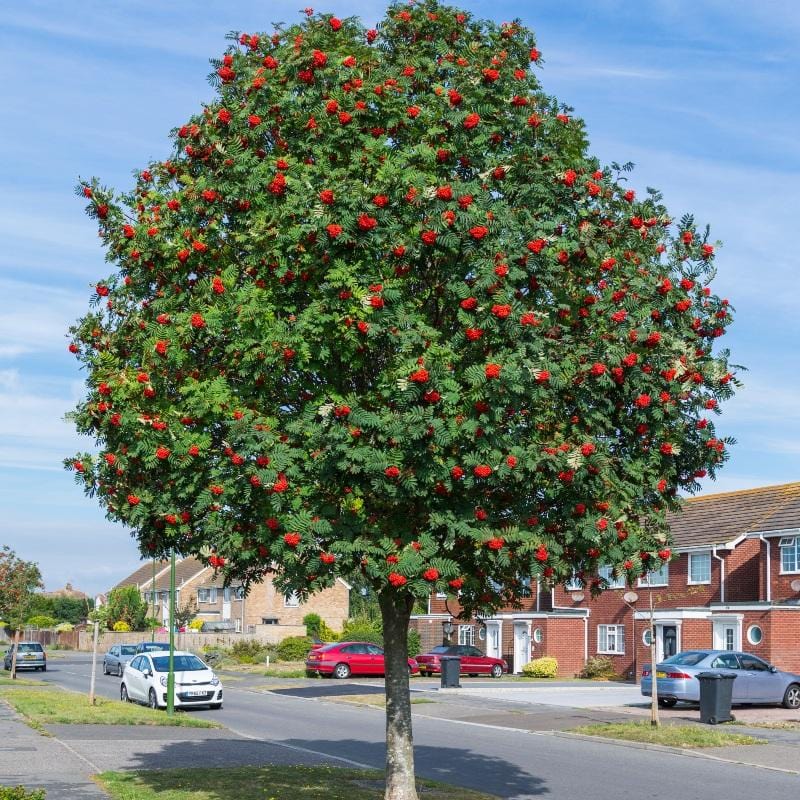
Rown

Rowan (Mountain Ash) – Sorbus aucuparia

Deciduous Tree • Woodland
Hardy native pioneer tree with feathery pinnate foliage, creamy-white spring blossom, and heavy clusters of scarlet berries in late summer. Exceptional ecological value across the farm for wild…
  • Sun/Exposure: Full Sun (6+ hrs)
  • Sow / Plant: Plant bare-root November – March while dormant. Stake and mulch immediately.
  • Harvest / Bloom: Blooms May – June (creamy flowers); Berry clusters ripen August – October.
  • Prune: Winter dormant (Nov–Feb). Minimal pruning required: remove dead, damaged, crossing branches or basal suckers. Avoid pruning in damp spring to prevent fungal entry.
  • Soil: Prefers slightly acidic, well-draining, fertile loam. Tolerates stony, thin, or poor upland soils. Dislikes waterlogged ground.
  • Water: Moist / Free-draining
⚠️ Hazards / Pests: Susceptible to fireblight in wet conditions; aphids on young leaf shoots; bark stripping by deer, rabbits, and voles (tree guard essential). Raw berries contain parasorbic acid and can cause stomach upset if eaten raw by humans (must be cooked/jellied).
Silver Birch – Betula pendula

Silver Birch – Betula pendula

Deciduous Tree • Woodland
Graceful native pioneer tree with silvery-white peeling papery bark, weeping twigs, and triangular fluttering foliage. Rapidly creates light dappled woodland canopy.
  • Sun/Exposure: Full Sun (6+ hrs)
  • Sow / Plant: Bare-root planting Nov – March
  • Harvest / Bloom: Foliage flush April; Catkins April–May
  • Prune: Prune strictly late summer/autumn (Aug–Sept); bleeds sap in spring.
  • Soil: Light, sandy, acidic or stony soils; dislikes waterlogging
  • Water: Moist / Free-draining
⚠️ Hazards / Pests: Birch polypore fungus on injured trunks; sap bleeding if pruned late.
Wild Cherry – Prunus avium

Wild Cherry – Prunus avium

Deciduous Tree • Woodland
Majestic native forest tree with glossy reddish-copper banded bark, spectacular clouds of white spring blossoms, and rich orange-crimson autumn colour. Provides sweet cherries for wildlife.
  • Sun/Exposure: Full Sun (6+ hrs)
  • Sow / Plant: Bare-root planting Nov – March
  • Harvest / Bloom: Blossom in April; Cherries in July
  • Prune: Only prune in mid-summer (July–Aug) to prevent silver leaf fungal spores.
  • Soil: Deep, fertile, moist but well-drained loam
  • Water: Moist / Free-draining
⚠️ Hazards / Pests: Silver leaf and bacterial canker; aphid distortion on young shoot tips.